
About (Artificial) Intelligence and Knowledge

Nothing evokes the feeling of infinity quite like stupidity.
— Ödön von Horváth
So, let us finally begin with the fundamentals of artificial intelligence. I am going to try to make the following articles into a series (let’s see whether I can actually keep that up). The goal is to provide an overview of what really lies behind all these terms like artificial intelligence, so that afterward we can return to discussing its consequences. But before we deal with artificial intelligence, we should first ask what natural intelligence actually is.
Well, long story short: the opposite of stupidity. We encounter the latter practically every day in our lives, so at least everyone has some idea of what that means 😉 Yuval Harari once said in a podcast (Alles Gesagt) that humanity always has to do all the stupid things first before it eventually does something intelligent (no guarantee on the exact wording — I am not listening to that five-hour podcast again just to find the exact quote 😅).
On Natural Intelligence
In fact, finding a direct definition of intelligence was not nearly as easy as I had expected. So let us first look at the literal origin of the word. It comes from the Latin intellegere, meaning something like “to perceive” and/or “to understand” — with inter meaning “between” and legere meaning “to read” or “to choose.” I quite like the latter, because in my opinion reading is one of the most important pillars for acquiring intelligence (sorry, friends — podcasts and videos are not shortcuts! Or at least not complete ones).
But now let us come to my own definition of intelligence, in which I try to find some common ground between different definitions (and one I am reasonably satisfied with):
Intelligence is a complex and multifaceted concept that refers to an individual’s ability to learn, understand, solve problems, apply knowledge, and adapt to new situations.
(my own definition)
The most important property here is learning, which forms the basic prerequisite for acquiring knowledge. And here we can already identify a similarity with artificial intelligence, because AI systems are also learning systems whose goal is to acquire knowledge. We will briefly return to the definition of knowledge later in this article. But first, let us take a look at the most important cognitive processes that intelligence encompasses:
Memory: Our capacity to remember. A part of our brain where we can store and retrieve acquired knowledge. Fun fact: unlike other areas of the brain, there is no single clearly demarcated or identifiable region dedicated exclusively to memory and recollection.
Judgment: The ability to meaningfully classify information, experiences, and observations, to connect them, and on that basis arrive at a reasonable evaluation or decision. Or simply: the ability not to believe every piece of nonsense immediately just because it is presented confidently (or comes from an expert). Judgment requires not only knowledge, but also reflection, contextual understanding, and the willingness — and ability — to distinguish between good and bad arguments. A skill that in times of social media, clickbait, and AI-generated “facts” may be more important than ever...
Understanding: More than merely absorbing or reproducing information. Understanding means recognizing relationships, grasping causes and effects, and internalizing knowledge in such a way that it can be applied to new situations. Put differently: having understood something does not mean having read it once or heard it in a podcast, but having truly grasped it mentally. This, by the way, is also where the difference lies between genuine education and mere information consumption.
The ability to think abstractly: The ability to think beyond what is concretely visible and to work with concepts, models, symbols, or general principles. Abstract thinking allows us to recognize patterns, form theories, imagine hypothetical scenarios, and solve problems that are not directly sitting in front of us on the table. Without this ability, there would be neither mathematics nor philosophy, neither strategic thinking nor scientific progress. Or, to put it a little more dramatically: whoever cannot abstract remains mentally trapped in the here and now — which may be enough for some TikTok feeds, but is rather problematic for civilization as a whole...
So, in summary, intelligence can be understood as the interaction of several cognitive processes that together form an emergent system, in which the whole is more than the sum of its parts (freely after Aristotle). Measurements such as IQ tests are scientifically controversial, as are genetic influences — controversial mainly in pseudoscientific circles, since in biology it is fairly clearly assumed that around 60–80% of IQ can be traced back to genetics.
Something About Knowledge & Intelligence, and Vice Versa
Now then, enough rambling about intelligence — let us turn, as announced, to knowledge. A term we constantly use in everyday life as though it were completely obvious what it means. I know that, people know this, science now knows — nice rhetorical formulas that usually make knowledge sound like something fixed, clean, and unassailable. Preferably combined with trust the science, trust the experts, and so on, because after all they know what they are doing 😉
In reality, of course, that is bullshit. Or to put it differently: not everything delivered with maximum confidence automatically qualifies as knowledge. Sometimes it is simply opinion with an extremely large ego. But once again we are drifting off — let us at least note that truly objective knowledge is virtually impossible, both for humans and for machines.
In very general terms, knowledge can initially be understood as the result of a learning process. It encompasses the totality of information, facts, concepts, theories, and principles that an individual has acquired across different fields and topics. Knowledge does not simply fall from the sky, nor is it innate. It arises through experience, education, observation, and learning. And that is where an important distinction from mere information lies: information can be consumed. Knowledge must be processed, categorized, connected, and ideally also critically questioned. Otherwise, it remains mental fast food.
Perhaps a small distinction may help here, using the so-called DIKW pyramid (see figure below) — whose origin, incidentally, is not at all easy to pin down, and during my PhD days I once read an entire paper just about the different representations and interpretations of this pyramid...
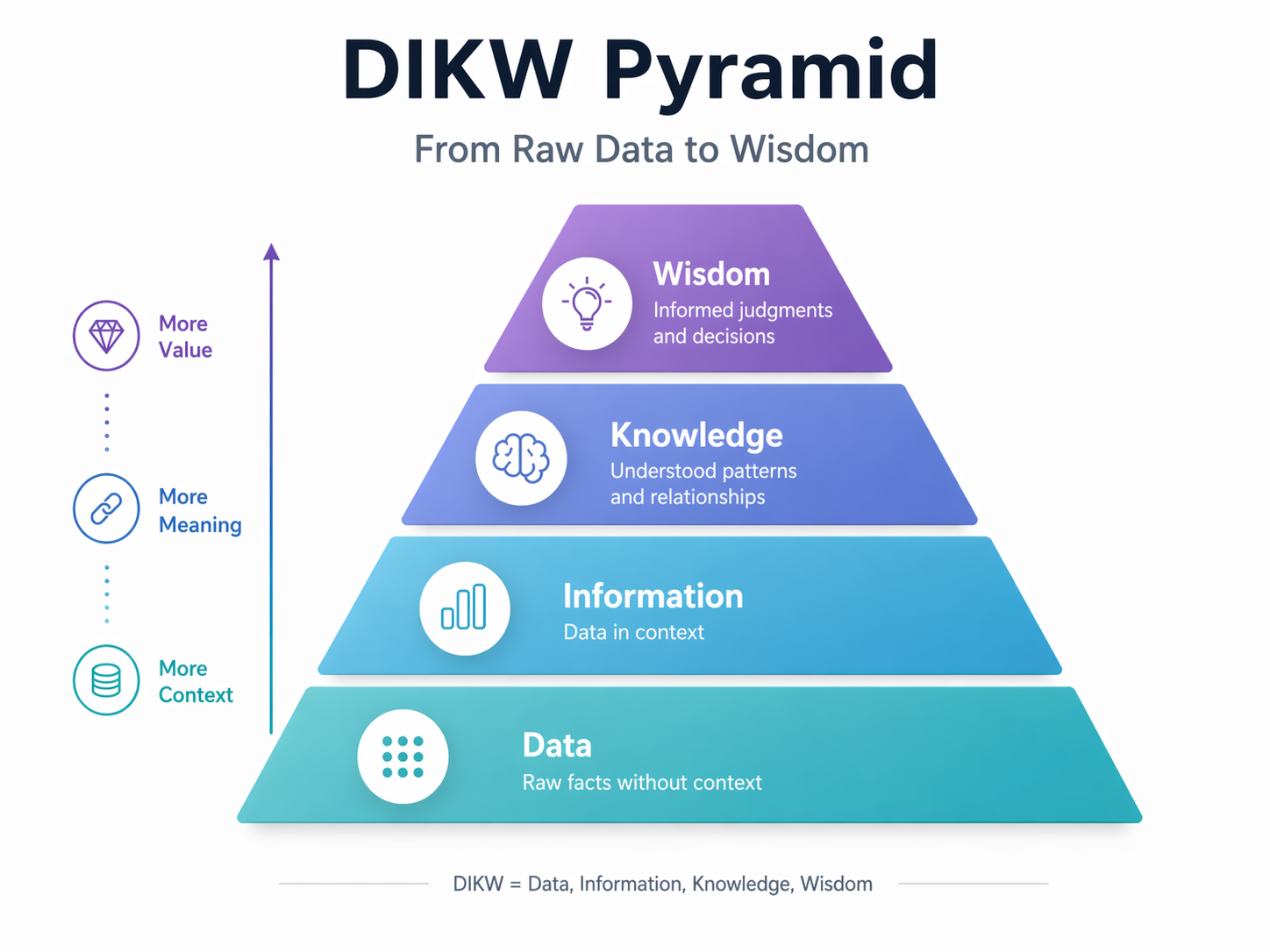
Data are, first of all, raw signs, numbers, symbols, or whatever — without context. Information arises when those data are placed into relation or considered within a context. Knowledge, in turn, only emerges when information is understood, categorized, linked with existing prior knowledge, and made usable for future action, just as already mentioned. We will return to the term wisdom in later articles and leave it uncommented here for now.
To sum it up: a Wikipedia article is not yet knowledge. A stored PDF is not knowledge either. And fifteen TikToks about a topic certainly are not. Knowledge begins where a human being starts to mentally penetrate the content.
And that brings us to the great paradox: intelligence is what makes the acquisition of knowledge possible in the first place. Without the ability to learn, understand, remember, abstract, and judge, we might be able to absorb data, but we could not turn them into robust knowledge. Intelligence is, in a sense, the tool, the process, or perhaps the prerequisite through which knowledge can arise at all. At the same time, the reverse is also true: knowledge is the foundation for the application of intelligence. Because even an intelligent person can hardly make wise decisions if they lack the necessary content, experience, and understanding of relationships. Intelligence without knowledge often remains superficial. Knowledge without intelligence often remains dead. Only in the interplay of both does what we would commonly call reasonable thinking emerge.
Knowledge in the Age of Information
Access to knowledge has never been as easy as it is today. Even large language models can simply pull it from the internet — and at the same time, we are getting dumber. The old saying that what costs nothing is worth nothing seems to prove itself yet again. Just because today, theoretically, almost everyone can access infinite amounts of information at any time does not mean that we actually know more. Quite the opposite. The mere availability of information does not produce insight; it often produces more noise first. Anyone who has never learned how to evaluate sources, tolerate contradictions, examine arguments, and distinguish the important from the unimportant does not accumulate education, but merely fragments of information. That can look impressive — especially on LinkedIn (warm regards to all the performative self-promotion posts there) or in talk shows and panel discussions (warm regards to all sociologists 😉) — but it is often little more than pseudo-intellectual bullshit.
From Knowledge to Artificial Intelligence
Wasn’t I actually supposed to be writing about AI?
Yes. And yes, I had actually intended to put artificial intelligence much more at the center of this article — perhaps I should plan my articles better. But really, that does not matter all that much, because in the end we have laid out a whole series of foundations that are indeed important for understanding what comes next. For the question of artificial intelligence, all of this matters because AI systems also go through similar (cognitive) processes. They too depend on data, information, and in some sense on knowledge — or at least on something that we are very quick to mistake for it.
A large language model, for example, processes gigantic amounts of data and information, recognizes patterns, establishes connections, and can thereby generate astonishingly convincing answers. But does it therefore possess knowledge in the human sense? Well, this is precisely where things become philosophically interesting. Because if knowledge is more than merely stored information — namely something bound up with understanding, classification, experience, and meaning — then the answer can only be: this is a wide field (Effi Briest readers will remember).
Now then, before this turns into a full-blown novel, let us make a cut here. In the next article of this still-emerging series, we will continue exploring the fundamentals and the history of artificial intelligence — and perhaps we will even take a closer look at that wisdom thing as well.
If you do not want to miss the upcoming articles in this series — and other exciting (or perhaps boring) articles by yours truly — feel free to sign up for the free newsletter on the homepage as well (: